
Feeling constantly short on time can make staying active seem harder than it should be.
The CDC confirms that any amount of physical activity provides health benefits, while muscle-strengthening activity supports stronger muscles and overall physical function.
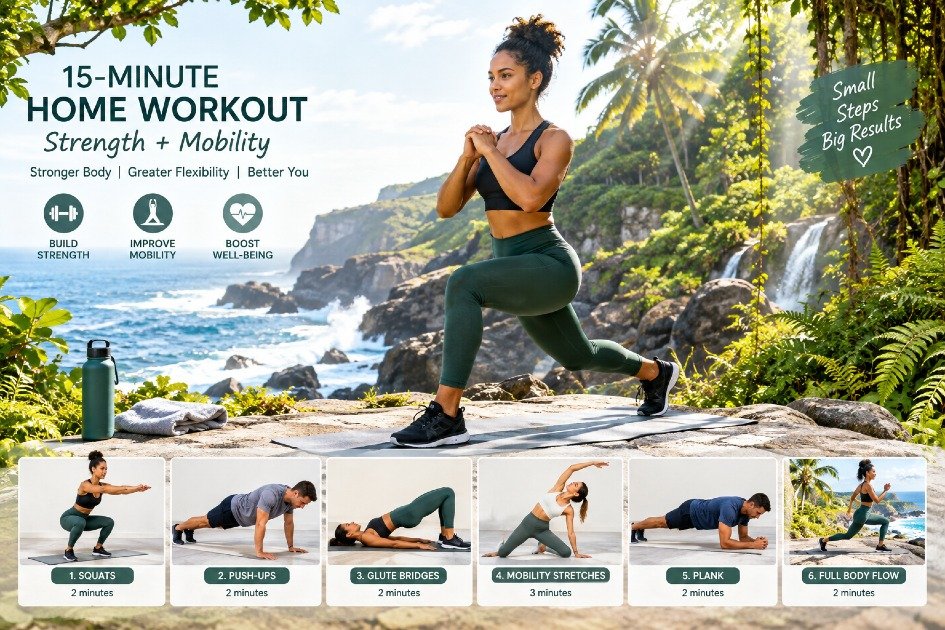
This guide explains how a 15-minute home workout gives you a practical way to move more, strengthen your body, and build confidence.
Why Strength and Mobility Matter
Limited movement and prolonged sitting can weaken muscles and stiffen joints, making everyday activities harder.
Regular strength and mobility exercises help improve movement, support joint function, and make daily tasks easier.
What a 15-Minute Home Workout Includes
Unstructured exercise can make it difficult to train major muscle groups and maintain flexibility consistently.
A short routine combining bodyweight strength, mobility drills, and controlled movements supports full-body strength and flexibility.
How to Complete Your 15-Minute Home Workout
Long or complicated routines can make exercise difficult to fit into a busy schedule.
Spend 5 minutes warming up, 7 minutes on strength and mobility exercises, and 3 minutes cooling down to build a practical, repeatable fitness habit.
Move Better, Feel Stronger With Just 15 Minutes a Day
Feeling stiff, weak, or too busy to exercise can make staying active seem impossible.
Make daily activities feel easier without complicated equipment or a long time commitment.
Discover how these 15 minutes a day can strengthen your body, improve your mobility, and take a powerful step toward feeling stronger every day.
Minute 0–2: March in Place

Marching in place for the first two minutes of your 15-minute home workout gets your body moving and builds momentum for the exercises ahead.
Why it matters:
This simple movement gently raises your heart rate, warms your muscles, and prepares your body for more activity.
What works for me:
I start with a comfortable march, lift my knees gradually, and use a fitness tracker to monitor my steps and stay motivated throughout my 15-minute home workout.
How to start:
- Stand with your feet about hip-width apart.
- Lift one knee comfortably.
- Alternate sides.
- Swing your arms naturally.
- Increase the pace gradually.
Minute 2–4: Bodyweight Squats

Bodyweight squats strengthen your legs and glutes, making them an effective move in any 15-minute home workout.
Why it matters:
Squats build lower-body strength, support mobility, and make everyday movements like sitting and standing easier.
What works for me:
I use controlled bodyweight squats with proper form and a fitness tracker to monitor my movement and stay consistent with my 15-minute home workout.
How to start:
- Stand with your feet approximately shoulder-width apart.
- Push your hips backward.
- Bend your knees comfortably.
- Keep your chest lifted.
- Press through your feet to stand.
- Complete about 8–12 controlled repetitions.
Minute 4–6: Wall or Counter Push-Ups

Wall or counter push-ups add simple upper-body strength training to your 15-minute home workout without requiring floor exercises.
Why it matters:
These modified push-ups build chest, shoulder, and arm strength while helping you develop better movement control.
What works for me:
I start with wall push-ups, progress to counter push-ups as my strength improves, and use a fitness tracker to monitor my 15-minute home workout progress.
How to start:
- Place your hands slightly wider than shoulder-width apart.
- Step your feet backward.
- Keep your body in a straight line.
- Bend your elbows.
- Bring your chest toward the surface.
- Push yourself away.
- Repeat for 8–12 controlled repetitions.
Minute 6–8: Reverse Lunges

Reverse lunges strengthen your legs and improve balance, making them a valuable move in your 15-minute home workout.
Why it matters:
Stronger legs and improved stability make daily activities easier and help you maintain an active lifestyle.
What works for me:
I use controlled reverse lunges with a resistance band for added challenge, helping me build lower-body strength and improve workout consistency.
How to start:
- Stand tall with your feet hip-width apart.
- Step one foot backward.
- Bend both knees comfortably.
- Push through the front foot.
- Return to standing.
- Switch sides.
- Perform 6–10 repetitions per side.
Minute 8–10: Glute Bridges

Minute 8–10 of your 15-minute home workout targets your glutes with simple, controlled bridges that build lower-body strength.
Why it matters:
Glute bridges strengthen your glutes and support hip stability, helping you move with greater control and confidence.
What works for me:
I use a non-slip exercise mat and a controlled glute-bridge routine to strengthen my glutes at home, with a resistance band for added challenge as my strength improves.
How to start:
- Lie comfortably on your back.
- Bend your knees.
- Keep your feet flat.
- Press through your feet.
- Lift your hips gradually.
- Pause briefly.
- Lower with control.
- Complete 8–12 repetitions.
Minute 10–12: Bird Dog

The bird dog exercise strengthens your core and improves balance, making it a valuable move in your 15-minute home workout.
Why it matters:
The bird dog exercise strengthens your core, encourages proper spinal alignment, and sharpens body coordination—all without the need for gym equipment.
What works for me:
I focus on slow, controlled bird dog repetitions using a non-slip exercise mat for comfort and stability during my 15-minute home workout.
How to start:
- Start on your hands and knees.
- Keep your spine in a comfortable neutral position.
- Extend one arm and the opposite leg.
- Pause briefly.
- Return to the starting position.
- Switch sides.
- Perform 6–8 repetitions per side.
Minute 12–13: Standing Hip Mobility

Minute 12–13 of your 15-minute home workout targets standing hip mobility to ease stiffness and improve everyday movement.
Why it matters:
Better hip mobility supports flexibility, balance, and smoother movement during daily activities.
What works for me:
I use controlled standing hip circles and gentle knee lifts, guided by a fitness tracker to monitor my 15-minute home workout and stay consistent.
How to start:
- Stand beside a stable chair or countertop.
- Hold it lightly for support.
- Move one leg forward and backward in a controlled manner.
- Switch sides.
- Keep the movement comfortable.
- Avoid forcing the range.
Minute 13–14: Shoulder Mobility

Tight shoulders can limit comfortable movement, but a few controlled stretches in your 15-minute home workout can help restore mobility.
Why it matters:
Shoulder mobility supports better posture, smoother arm movement, and greater comfort during everyday activities.
What works for me:
I use a resistance band for gentle shoulder rotations during my 15-minute home workout to improve mobility and build a consistent stretching routine.
How to start:
- Stand tall.
- Circle your shoulders backward slowly.
- Reverse the direction.
- Reach your arms overhead only as far as comfortable.
- Lower them slowly.
- Repeat several times.
Minute 14–15: Slow Breathing and Full-Body Reset

Conclude your 15-minute home workout with gentle, controlled breathing and a full-body relaxation routine to ease muscle tightness and regain a sense of calm.
Why it matters:
Slow, steady breaths help settle the body’s stress response, while gentle stretches loosen tight muscles after physical activity.
What works for me:
I finish with deep, gentle breaths and a full-body stretch, using a fitness tracker to monitor my workout consistency and recovery.
How to start:
- Relax your shoulders.
- Breathe comfortably.
- Take a slow walk around the room if needed.
- Notice areas that feel tight.
- Avoid aggressive stretching.
How to Make Time for a 15-Minute Home Workout on Your Busiest Days
A busy schedule can push exercise aside, but a 15-minute home workout makes daily movement easier to manage.
Finding time for exercise is difficult when work, family, and daily responsibilities compete for attention.
A 15-minute home workout helps you build consistency, improve strength and mobility, and support better energy without disrupting your busy day.
How to Make the Workout Harder Without Making It Longer
You can make your 15-minute home workout more challenging by increasing resistance, slowing repetitions, or reducing rest without adding extra time.
Repeating the same exercises at the same intensity can limit progress in strength, endurance, and mobility.
Gradually increasing workout intensity helps build strength, improve endurance, and make every 15-minute home workout more effective without extending your routine.
How Often Should You Do a 15-Minute Home Workout?
A consistent 15-minute home workout can improve strength and mobility, but the right weekly frequency helps you stay active without overtraining.
Knowing how often to do a 15-minute home workout helps you build consistency, allow muscle recovery, and progress safely toward your fitness goals.
A consistent 15-minute home workout routine helps build strength, improve mobility, and develop sustainable fitness habits that support long-term health.
Ways to Get More From Your 15-Minute Home Workout
A focused 15-minute home workout can deliver more value when you use proper form, purposeful movements, and consistent effort.
Rushed movements, poor technique, and unnecessary breaks can limit the results of your 15-minute home workout.
Improve strength, mobility, and workout efficiency by using proper form, minimizing distractions, and making every minute count.
Can a 15-Minute Home Workout Build Strength?
A 15-minute home workout can help build strength through consistent bodyweight exercises and gradual increases in effort.
Short workouts may seem too brief to build strength, especially without gym equipment or heavy weights.
A consistent 15-minute home workout can improve muscle strength, support mobility, and make daily activities easier when exercises progressively challenge your muscles.
Equipment That Can Improve Your Home Routine
The right home workout equipment can make daily exercise simpler, more comfortable, and easier to maintain.
Limited time, space, or workout variety can make it harder to stay consistent with a 15-minute home workout.
Use versatile tools like resistance bands, dumbbells, and an exercise mat to build strength, improve mobility, and make every 15-minute home workout more effective.
Safety Tips Before Your 15-Minute Workout
Prepare your body for a safe 15-minute home workout with a few simple checks before you begin.
Skipping basic safety checks can increase your risk of injury, dizziness, or muscle strain.
Warming up, clearing your workout space, and choosing suitable movements help reduce injury risks and make your 15-minute home workout safer and more effective.
Frequently Asked Questions
Is a 15-minute home workout enough for beginners?
A 15-minute home workout can help beginners build strength and mobility, with room to increase activity as fitness improves.
Can I do a 15-minute home workout every day?
Move daily, but alternate strength workouts with walking, gentle mobility, or recovery days to give your body time to adapt and get stronger.
What Is the Most Effective 15-Minute Home Routine for Building Strength?
A powerful 15-minute home workout combines squats, push-ups, lunges, bridges, and core exercises to strengthen major muscle groups with no equipment.
Can I build muscle with a 15-minute home workout?
A 15-minute home workout can build muscle when you progressively increase resistance with bands, dumbbells, or harder variations as your strength improves.
Is a 15-minute home workout good for mobility?
Yes—combine controlled hip, shoulder, spine, and ankle movements with strength exercises to improve movement control and mobility.
Recap: Make 15 Minutes Your Daily Strength Goal
You don’t need hours at the gym to start building strength, mobility, and confidence. Commit to just 15 focused minutes a day and turn this home workout into a realistic habit you can maintain.
Move for 15 minutes, strengthen your body, improve your mobility, and build consistency—one session at a time.
Start today, track your progress, and let those 15 minutes become a lasting investment in how you move, feel, and live.
Ready To Make 15 Minutes Count?
Still skipping workouts because you think you need an hour?
Discover how pairing your home workouts with a fitness tracker monitors steps, active minutes, heart rate, and daily progress—making 15 minutes a daily commitment toward a stronger, more mobile you.